Directory
Beer In the Cemetery
Overview
Ancestor Biographies
Ely Diaries
Links to Lords
Pedigree Charts
Civil War Letters of Henry Sill Lord
John G. Ely Journal
Civil War Letters of Dexter Lord
Return to
Home Page
Warner P. Lord
141 WildcatRoad
Madison, CT 06443
 Henry Sill Lord (1839)
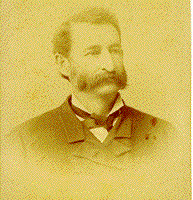
Henry Sill Lord (91K image), William John's oldest son, married Elizabeth Alice Ely, daughter of John Griswold Ely and Sally Pratt Williams. We have no records of Henry's early life except that he was born in 1839 in Old Lyme. We meet him first in Elizabeth Ely's journal where she speaks of being escorted by Mr. Lord. Mr. Lord becomes a frequent companion of Lizzie's. On Monday, July 5, 1858 she writes:
Vacation this week. I arose early this morning and went to washing; about 6 o'clock Gilbert LaPlace came and invited Ellen and I to go a sailing, and about 9 o'clock we started. We went down to Lyme Ferry and stopped and took dinner and stopped to the Fenwick house, from there to Essex, went to the ice-cream saloon, and from there to Deep River and then home. Henry Lord was my escort.
And so our great grandfather Henry Sill Lord and our great grandmother Elizabeth Alice Ely had their first date. They went sailing with their friends, attended sewing society meetings spent evenings together, and traveled to New haven to view the fireworks one fourth of July. Henry often sent her gifts of fruit, sheet music and once, a handkerchief.
It is through Lizzie's journals that we begin to learn more about Henry. An entry for November 16, 1859 reads in part, "Mr Lord escorted me home. He has left Lyme Hotel and is now in Col. E Brockway's store." Col. Brockway's store was in Hamburg, Connecticut.
Lizzie and Henry often went to the Lyme Hotel, apparently operated by Henry's family, for dinner and to visit with William John Lord and his family. Henry called on Lizzie on his 21st birthday, February 11, 1860. Earlier he had presented her with a locket containing his photograph.
April 12, 1860 was a fateful day in Lord family history. Lizzie records it nicely:
Thurs Apr 12th 1860 In the morning I started to walk to Hamburgh, overtook a cart and rode over to the store in it. Called at the store, to Uncle Calvin's, Munroe Brockway's, then went to Uncle Wms. Pitt came home at night. Henry Lord came down in the evening and the result of our evening's conversation was an engagement for life, may I never regret the step I have taken. I think I never shall. We have kept company some time, and as far as I am acquainted with him I think we would live happily together.
Henry and Lizzie kept company for nearly two years before their engagement. Their marriage is recorded simply by Lizzie, "Married Jan 22nd 1862 H.S. Lord and myself E. A. Ely."
Monday, March 17, 1862, Henry left his wife of a few months to join the 13th Regiment on its journey to Louisiana to begin service during the Civil War. There is no record that .Henry ever held military rank. He did not join the same unit that Amos and Dexter joined. This seems odd as their unit was composed of men from New London County. Off Henry went and he and Lizzie began a letter writing marriage. Many of his letters from Louisiana were preserved and transcribed by Diana for us all to enjoy. Reading the letters gives the distinct impression that Henry was the company supply clerk who was paying as much attention to his own fortunes as he was to the company's. He length of service was short and he was home before his brothers Amos and Dexter set out for Louisiana.
Among the scraps of paper saved by generation of Lord's are to that relate to Henry's Civil War service. The first reads:
Department of the Gulf, New Orleans, Aug 2nd 1862. H.S. Lord has taken and subscribed the oath required by General Orders No. 41 for a citizen of the United States. (signed) Capt C. S. Leach for the Provost Marshall.
The second reads:
Norwich August 15th 1863. Received from Henry S. Lord three hundred and ten dollars for furnishing a substitute and agree to furnish his exemption papers or the money. (signed) C. A. Delaney.
Henry didn't think much of military life and paid someone else to serve in his place. This is further confirmed by an entry in Lizzie's journal that mentions that Henry's substitute visited them.
This version of Henry's military service is quite different from that reported in his obituary which reads in part, "--a short time spent in New Orleans during the war, where he was attached to the army secret service corps under General B. F. Butler."
Hmm, maybe the supply clerk job was just a cover and Henry was really a spy!
Henry and Lizzie's first year of marriage set the pattern for their married life. Henry spent long periods away involved in work or deals. He and his wife corresponded regularly and it from these letters that we know much of what their lives were like. Henry wasn't much for sticking too long at any one thing. He loved to start things but rarely saw them through to conclusion. During his life he was a real estate developer, hotel clerk, inventor, promoter, spy and devoted husband. Scattered about the Connecticut landscape are evidences of his work: He was among the original purchasers of the land for the Hatchet's Point Colony in South Lyme. He superintended the construction and laying out of the grounds for the New Saybrook Hotel (Fenwick Hall) and secured the pilings for the bridge across South Cove in Saybrook (pilings that still remain today), a house at 11 Academy Street in Old Lyme bears this plaque, "Begun for Henry Sill Lord", he served in the Connecticut General Assembly in 1869 as the representative from Lyme and he active in promoting the Connecticut Valley Railroad. The land records of Lyme and other town contain evidence of his land purchases.
Records in the Old Lyme Town reflect one of Henry's adventures into real estate. From April of 1874 to April of 1875 he rented a house and land on Academy Lane in Old Lyme from Charles W. Wait for $150.00 a year. Among family papers is the hand written document that records this activity. In February 1, 1875 Henry bought a lot from Mary P. Sill, widow of H. L. Sill. The widow Sill seems to be developing a tract of land as there is mention of lot numbers and a proposed road. The lot Henry purchased is now 11 Academy Lane where stands the house with the plaque announcing it was begun for Henry Sill Lord. The land was bounded west by the Lieutenant River, and north by the Beckwith Lane and contained about three acres. It appears from the records that the land was the same as or close to the land rented from Charles Wait.
In April of 1875 Henry purchased a second piece of land from his brother-in-law, Merritt Comstock for $400.00. This lot was about a half acre with frontage on the Lieutenant River. In December of the same year he bought a strip of land from Mary Sill about 10 feet wide running along the present Lieutenant River Lane. Cost $25.00
In February of 1876 he mortgaged to David B. Hamilton of Waterbury, his banker brother-in-law, the land he bought from Mary P. Sill which by now contains a house and one and a half acres for $2400.00. Perhaps he was converting assets to cash for further speculation. Sort of a home equity loan!
In 1881 he involved himself in a deal that was characteristic of him. He was working for a plumbing supply company in Hartford and had made contacts with other investors. He and three other men purchased 200 acres of land from Valentine Smith of Old Lyme for $4400.00 and a $1600.00 mortgage. The property is now the Hatchets' Point Colony. Henry did not keep his interest in the property very long. But then Henry never stuck to anything. It would have been nice to have inherited a piece of the Hatchets' Point Colony.
Hatchet's Point is the burial place of Lathrop E. Slate, our beloved Uncle Lote who served as caretaker there for many years.
In July 1884 Henry paid off his mortgage to David Hamilton and later in the same year mortgaged the same property to the Deep river Savings Bank for $2200.00. Henry was living in Hartford so who was living in the house at 11 Academy Lane? The land mentioned in the mortgage deed contains three acres and three acres including the piece he bought from Merritt Comstock. On September 14, 1886 the Deep River Savings Bank sued Henry to foreclose on the mortgage. December 30, 1887 they foreclosed on all of Henry's holdings on Academy Lane and so ended another deal.
Henry Sill Lord traveled all about the country on his business jaunts from Washington, D. C. to San Francisco, CA. In his later years he obtained 7 patents for plumbing fixtures and during his last days he was busily promoting a patented alcohol distillation process that would make cheap, high quality, brandy available to the general public. The financing was promised, the manufacturing facility secured and it looked like at last he was going to hit it big! Fate intervened, his health was failing and he died with another dream unrealized. The final paragraph of his obituary reads:
Mr. Lord leaves a wife, who was Miss Elizabeth Ely of Lyme, a son, Archie E. Lord, Bookkeeper for the Manfacturer's National Bank of Waterbury and a daughter, Miss Isabel E. Lord, librarian of Bryn Mawr college, near Philadelphia. One son, Henry Hamilton Lord, died in 1883 when 7 years old and is buried at Lyme. Mr. Lord also leaves two brothers and three sisters all living at Ivoryton, Essex. They are William Lord, Frank W, Lord, Mrs. W. H. Stannard, Mrs. C. P. Jones and Mrs. M. A . Comstock.
Henry Sill Lord was a Connecticut Yankee with an eye for an opportunity. I expect if each of the Lord relatives looks deep into their souls they will find a little bit of Henry Sill lurking there. Henry and Elizabeth are buried in the Ely Burying Ground in Lyme with their son Henry Hamilton Lord and their daughter Isabel Ely Lord. They lie there where Elizabeth came with her friends to drink beer. Archie Ely Lord and his wife Mildred Warner Lord are buried not far away in he Joshuatown cemetery on the road to Brockways Ferry where Henry and Elizabeth spent many of their courting days.
Updated February 17, 2001